Two apprenticeship training providers can deliver the same apprenticeship standard and achieve very different outcomes.
One may support the vast majority of learners through to successful completion. Another may see a much lower proportion achieve, despite delivering the same qualification to a similar audience.
For employers, these differences matter. Apprenticeships require investment, planning, and support from both the employer and the learner. When programmes don’t result in successful outcomes, the impact can be felt across workforce development, productivity, and long-term skills planning.
This is where apprenticeship achievement rates become important.
Achievement rates provide a useful way to compare provider performance, but they tell you more than you might think. Behind every achievement rate sits a combination of factors that influence whether learners stay engaged, develop new skills, and successfully complete their programme.
Understanding those factors can help employers make more informed decisions when comparing providers and interpreting apprenticeship outcomes data.
In this article, we’ll explore some of the key reasons why apprenticeship achievement rates vary between providers, and what employers should look for when evaluating provider performance.
What influences apprenticeship achievement rates?
There is no single factor that determines whether an apprentice successfully completes their programme.
Apprenticeship achievement rates are influenced by a range of factors, including learner support, employer engagement, programme delivery, cohort size, and a provider’s experience delivering a specific apprenticeship programme.
While every learner’s circumstances are different, providers with consistently strong apprenticeship completion rates often share common characteristics in the way they support learners, work with employers, and manage delivery.
Learner support and early intervention
Even the most capable learners can encounter challenges during an apprenticeship. Work pressures, personal circumstances, changes in role, or difficulties with the programme itself can all affect engagement and progress.
What often separates higher-performing providers is how quickly those challenges are identified and addressed.
Regular reviews, one-to-one coaching, progress monitoring, and structured support processes can help identify learners who may be at risk of falling behind before small issues become larger barriers to achievement.
Early intervention is particularly important because learner disengagement is rarely sudden. More often, it develops gradually through missed deadlines, reduced participation, or declining confidence. Providers that are able to recognise these signs early and provide targeted support may be better positioned to help learners remain on track and complete their programme successfully.
Employer engagement and provider support
Apprenticeship success isn’t solely the responsibility of the learner or the training provider. Employers also play an important role in creating an environment where apprentices can develop, apply new skills, and remain engaged throughout their programme.
Line managers often have the greatest day-to-day influence on an apprentice’s experience. They can help learners balance training with workload, provide opportunities to apply new knowledge in the workplace, and offer encouragement when challenges arise.
However, effective employer engagement doesn’t happen automatically.
Higher-performing providers often invest significant time in supporting employers as well as learners. This may include setting clear expectations at the start of the programme, providing regular progress updates, involving managers in review meetings, and offering guidance on how to support apprentices effectively in the workplace.
This collaborative approach helps ensure that learners receive consistent support from both their employer and training provider. It also makes it easier to identify potential issues early, agree actions, and keep apprentices progressing towards successful completion.
For employers comparing apprenticeship providers, it’s worth understanding not only how a provider supports learners, but also how they work with employers throughout the apprenticeship journey. Strong communication, regular reviews, and clearly defined responsibilities can all contribute to stronger apprenticeship outcomes over time.
Programme design and delivery quality
Even when providers are delivering the same apprenticeship standard, the learner experience can vary considerably.
Factors such as curriculum design, coaching quality, training schedules, and End Point Assessment (EPA) preparation all influence how effectively learners develop the knowledge, skills, and behaviours required to succeed.
Well-designed programmes provide a clear learning journey, helping apprentices build confidence and competence over time rather than overwhelming them with information or leaving long gaps between support. Regular opportunities to apply learning in the workplace can also help reinforce new skills and maintain engagement throughout the programme.
The quality and consistency of coaching can be particularly important. Effective coaches do more than deliver training content. They help learners connect learning to their role, provide constructive feedback, challenge assumptions, and offer support when obstacles arise.
Preparation for End Point Assessment can also have a significant impact on achievement rates. Providers that embed assessment preparation throughout the programme, rather than treating it as a final-stage activity, may be better positioned to help learners approach EPA with confidence.
For employers, many of these factors can be difficult to assess from achievement rate data alone. Understanding how a provider structures delivery, supports learners throughout the programme, and prepares them for assessment can provide valuable context when comparing apprenticeship providers.
Cohort size and the learner experience
The size of an apprenticeship cohort can also influence the learner experience.
While there is no single “ideal” cohort size, the number of learners being supported within a training group can affect how much individual attention apprentices receive and how easily providers can identify learners who may need additional support.
In smaller cohorts, coaches and tutors may find it easier to build relationships with learners, understand their individual circumstances, and spot early signs of disengagement. Learners may also feel more comfortable asking questions, contributing to discussions, and seeking help when they need it.
Larger cohorts can offer benefits too, including broader peer networks and the opportunity to learn alongside a wider range of individuals and experiences. However, as cohort sizes increase, maintaining the same level of personalised support can become more challenging.
This is why many providers place limits on cohort sizes or implement structures designed to ensure learners continue to receive consistent support as programmes grow.
For employers, cohort size is rarely visible in published performance data, but it can be a useful question to ask when evaluating providers. Understanding how training is delivered, how learners are supported, and how providers maintain engagement across different cohort sizes can help build a more complete picture of the learner experience.
Ultimately, apprenticeship achievement rates are influenced not only by what is taught, but also by how learners experience the programme on a day-to-day basis.
Experience delivering specific apprenticeship programmes
Not all apprenticeship providers perform equally across every programme they deliver.
A provider may achieve excellent outcomes in one apprenticeship standard while achieving more average results in another. This can happen for a variety of reasons, including the experience of the delivery team, the maturity of the programme, employer demand, and the provider’s level of specialism within a particular subject area.
For employers, this means that overall provider achievement rates only tell part of the story.
A provider with a strong overall achievement rate may not necessarily be the strongest performer in the specific apprenticeship programme you’re looking to deliver. Equally, a provider with a more modest overall achievement rate may achieve exceptional outcomes within a particular subject area.
This is why programme-level achievement rates are often more valuable than provider-wide figures when evaluating apprenticeship providers.
Looking at performance within the specific apprenticeship standard you’re considering can help answer questions such as:
- Does the provider have a strong track record in this area?
- Are outcomes consistently above the national benchmark?
- How many learners have completed this programme?
- Is this a well-established part of their provision, or a relatively new offer?
Understanding programme-level performance helps employers move beyond broad assumptions and focus on the outcomes that are most relevant to their organisation.
After all, when choosing an apprenticeship provider, the question isn’t simply whether they deliver successful apprenticeships. It’s whether they deliver successful apprenticeships in the programme you’re investing in.
Achievement rates tell you more than you might think
Apprenticeship achievement rates are often viewed as a simple measure of outcomes. In reality, they can reveal far more about a provider’s approach to delivery.
Behind every achievement rate sits a combination of factors that influence learner success. The quality of learner support, employer engagement, programme delivery, cohort structure, and subject matter expertise can all play a role in shaping outcomes.
This is why achievement rates remain one of the most useful indicators available when comparing apprenticeship providers. They don’t just show whether learners completed their programme. They can also provide insight into the systems, support, and delivery practices that helped those learners succeed.
For employers, understanding these factors can make it easier to ask the right questions, evaluate apprenticeship provider quality, and make more informed decisions when selecting a training partner.
The next step is understanding how providers compare.
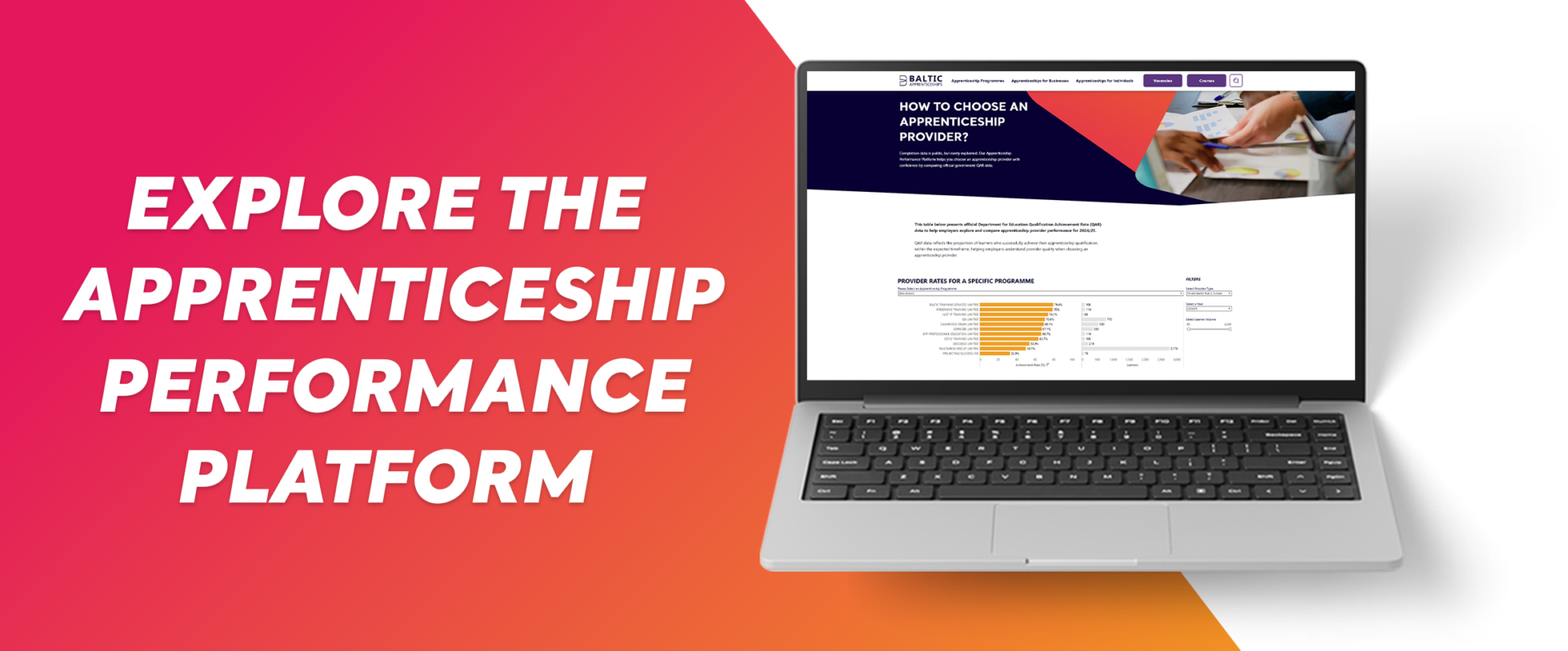
Our apprenticeship performance platform allows you to compare provider achievement rates, benchmark performance, and explore programme-level outcomes across the apprenticeship market.
The platform brings together:
- Achievement rates for all providers
- Programme-level data across standards
- National benchmark comparisons
- Side-by-side provider comparisons
All in one place.
This makes it easier to sense-check performance, compare providers on a like-for-like basis, and build a clearer picture of outcomes before making a decision.