
When people talk about adopting AI in business, the conversation usually turns straight to off-the-shelf tools, chatbots, or wrapping a single large language model in fancy branding.
At Baltic Apprenticeships, our goal has always been broader. As part of our wider AI ecosystem strategy – which underpins how we help businesses build practical, real-world AI capabilities -we wanted to build a system we trust internally. That meant building a solution that solves real operational friction, protects business data, and empowers our team to work smarter.
Enter Kidge: the brains of Baltic.
(Fun fact – it’s named after our Facilities Manager, Andy Kidger. Much like the man himself, the platform helps keep operations running and knows exactly where everything is.)
Kidge isn’t just a standalone chatbot. It’s an internal platform designed to work directly alongside our employees.
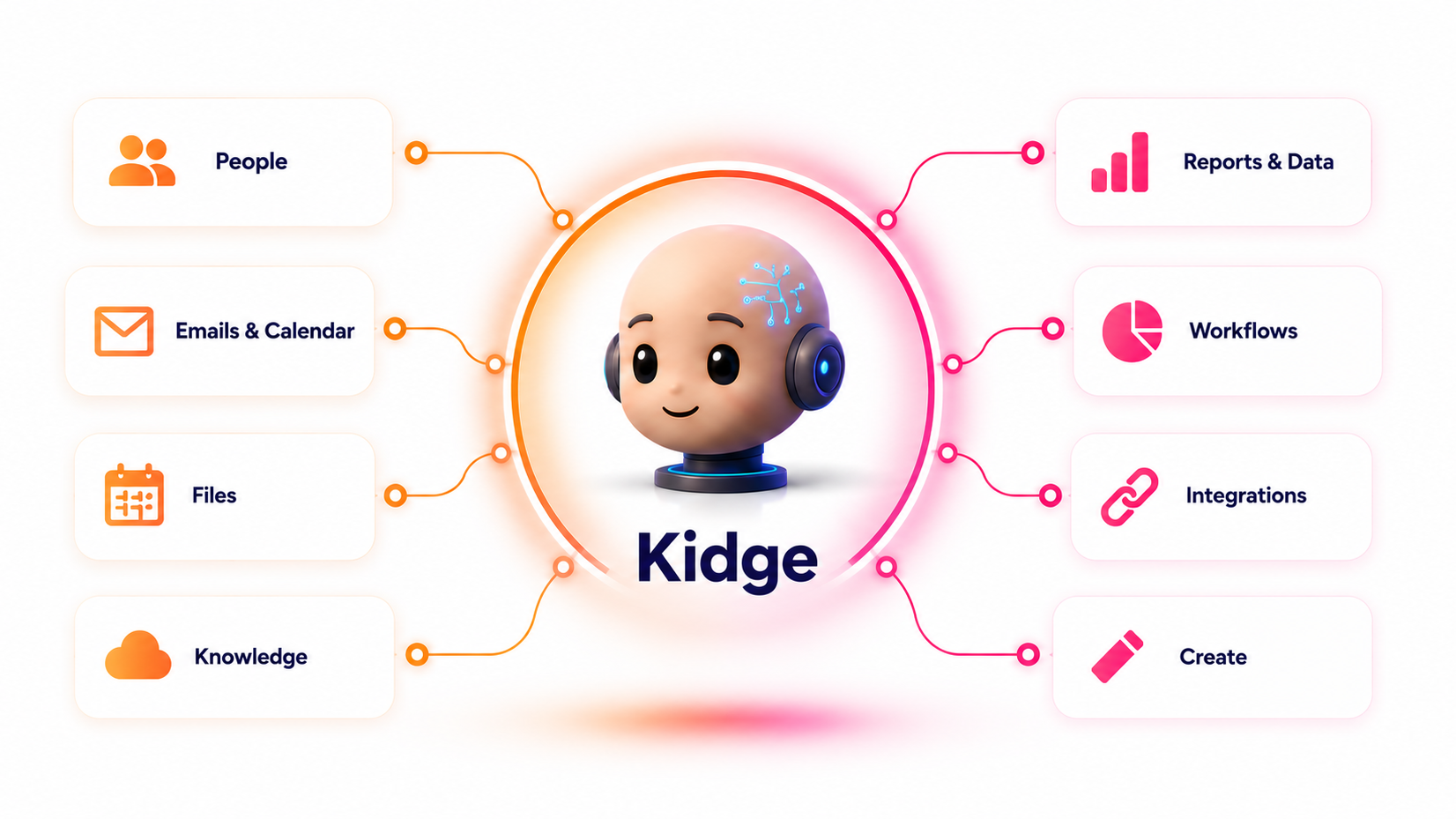
Here is a look at how we built it, what it can do, and why we took a platform-first approach.
Why We Built Our Own Layer
We didn’t set out to build our own large language model. Frontier AI models are evolving too quickly for that to make sense for our use case. Instead, we focused on owning the orchestration, company knowledge, permissions, tools, memory, and user experience around them.
While the underlying AI model provides raw intelligence, the tools we build and connect provide true capability. That tool layer is what makes Kidge bespoke and genuinely useful for us internally.
Building Kidge also gives us a safe, controlled experimentation layer. When new models or capabilities come out, we can connect, test, and evaluate them within the platform without employees independently signing up for third-party products. This allows controlled, secure adoption across the business.
10 Key Architecture & Strategy Highlights
Platform, Not Just Chatbot
The chat UI is just one door. The core services are designed to be reusable across future interfaces and applications, including the agentic and local-file workflows we’re currently exploring.
Right Tool for the Job
Kidge is being designed around using the simplest suitable tool for each task, whether that’s a model call, deterministic code, an existing workflow, or a combination of them.
Multi-Level Memory
Context carries across single chats, individual users, and entire multi-person project spaces so teams don’t have to re-explain background goals repeatedly.
Grounded in Company Knowledge
Kidge retrieves internal information through our custom RAG system, so users can ask natural-language questions across internal sources without needing to know which system or folder holds the answer.
A Common Tool Layer
Kidge can connect AI models to approved company systems and data sources through reusable tools and connectors. We’re also exploring and using standards such as MCP servers to make those capabilities portable between models and applications.
Human-in-the-Loop & Governance
As Kidge becomes more capable of taking actions, we keep humans accountable. AI can propose actions, but execution remains controlled. Permission to see something does not mean permission to change it.
Least Privilege & Scoped Permissions
We operate on the principle of least privilege – AI tools should only have access to the exact information and actions needed for the immediate task. Crucially, Kidge is designed to respect the permissions and scope of the person using it, so Kidge always acts within the appropriate scope.
Selective Privacy Safeguards
Kidge is being designed so that sensitive information can be minimised, anonymised, or kept away from external models where appropriate, while allowing public or safe data to process normally.
Stable Platform, Evolving Models
Different models excel at different jobs, and the landscape changes fast. Kidge acts as a stable platform while the models underneath evolve, allowing us to balance capability, speed, privacy, and cost.
Brand-Aware Generation
Instead of relying on AI to approximate our look, Kidge uses our actual brand guidelines and SVG logo assets.
Kidge in Action: Early Use Cases
We are already seeing early internal use cases transform everyday tasks across Baltic:
| Operational Area | How Kidge Has Helped |
| Instant Dashboards | Creates quick visual data summaries for ad-hoc questions without needing a full BI build |
| Document Retrieval | Searches across disconnected folders and reports so staff don’t need to know file paths. |
| Branded Assets | Generates presentation-ready imagery incorporating official Baltic logo files. |
| Data to Files | Pulls internal records and automatically generates downloadable .xlsx or .csv files. |
| Project Context | Keeps background context active across multi-week projects for entire working teams. |
| Productivity Tools | Handles small everyday admin tasks via natural conversation without jumping between systems. |
| Interactive Learning | Generates self-contained HTML activities to support our self-led curriculum development. |
5 Key Lessons We’ve Learned Building Kidge
- Not every problem needs AI: Sometimes deterministic code or a simple automation is faster, cheaper, and more reliable.
- The model is often the easiest part: Integrating context, system connections, and robust permission management takes up the real effort.
- Good AI needs good company data: Retrieval quality depends entirely on how well-structured and accessible your underlying information is.
- Tools create real utility: AI becomes significantly more useful when it can execute tasks via tools rather than just generating chat text.
- Decouple the engine from the platform: Build your architecture so today’s AI model can easily be swapped for tomorrow’s without breaking your workflows.
The Practical Future of Business AI
The true value of Kidge isn’t about chasing tech trends. It’s about creating a seamless bridge between finding information, turning it into useful assets, and taking action in existing tools.
By building a secure, model-agnostic foundation, we can continuously test where AI genuinely adds value, give our team a safe space to experiment, and eliminate repetitive work.
Interested in exploring how AI skills and practical adoption can transform your own teams?
Check out our AI Skills Training and AI Skills Consultation options to get started.