
AI Enablement
Our Level 3 AI Enablement programme enables learners to use AI confidently, reducing manual work, and improving how systems are used across the business.
Combat rising cyber risks with cybersecurity apprenticeships. Learn to identify phishing and social engineering threats. Protect your business and embed security into every support role with Baltic’s cyber-focused IT apprenticeship programmes.
In 2025, Marks & Spencer became the latest high-profile victim of a growing cyber trend: attacks that bypass technical defences by targeting people. This is NOT an isolated case…
From The North Face to Adidas, recent breaches have exploited human vulnerabilities at an individual staff level, not system flaws. Cybercriminals are shifting their focus from firewalls to frontline staff, and sectors like retail and Managed Service Providers (MSPs) are especially at risk.
The message is clear: the most advanced cybersecurity tools mean nothing if your people aren’t prepared. Until awareness is embedded into the day-to-day decisions of every IT Support Technician, Infrastructure Engineer, and frontline employee, businesses will remain exposed, emphasising the importance of cybersecurity apprenticeships.
Read MoreThese attacks exploit frontline staff and support teams, those handling tickets, resolving access issues, and interacting directly with users and systems, providing attackers with an ideal method of getting behind security measures.
Traditional cybersecurity focused on fixed network boundaries, but with common computer security threats shifting, every employee with system access is a potential entry point for cyber threats. Staff are prime targets for phishing, social engineering, and credential theft.
Cybercriminals rely on human error because it’s the weakest link. A single click on a malicious link, a reused password, or a missed warning sign can lead to serious breaches and financial loss.
Even the most sophisticated security tools can’t protect against untrained users. If your people don’t understand threats or know how to spot them, your business is vulnerable – no matter how advanced your software is, making investing in cybersecurity apprenticeships a top priority for your business.
Social engineering is one of the most dangerous and overlooked cybersecurity threats because it doesn’t target systems; it targets people.
Our interactive Be-Spoke course empowers learners across every department in your business, with the skills to recognise, respond to, and report social engineering attacks – threats that manipulate human psychology rather than technology.
Through real-world examples, participants explore how cybercriminals exploit trust, urgency, fear, authority, curiosity, and reciprocity to deceive individuals and gain access to sensitive systems or data.
With a focus on prevention and escalation, our cybersecurity apprenticeships allow learners to gain confidence in using tools like multi-factor authentication, password managers, and device encryption, and in reporting suspicious activity quickly and effectively.
Check Out our Be-Spoke Course NowWithin our Cybersecurity Apprenticeships, our training is designed to build cyber-conscious Technicians and Engineers who understand that every user interaction, system access request, and technical decision carries security implications.
Cybersecurity is seamlessly integrated throughout our Level 3 IT Support Technician apprenticeship – ensuring learners build secure habits alongside core technical skills.
Apprentices are trained to:
🎯 Follow structured support processes aligned with organisational policies, reducing risk through consistency and professionalism.
🎯 Apply the CompTIA troubleshooting methodology to detect anomalies early, respond securely, and avoid risky, ad-hoc fixes.
🎯 Set up systems with a security-first mindset, managing updates, user access, and configurations to limit vulnerabilities.
🎯 Maintain accurate asset registers, helping organisations track devices and software for improved visibility and cyber hygiene.
🎯 Understand key networking components, including routers, firewalls, IP protocols, and how to monitor traffic securely.
🎯 Support secure cloud environments and remote device access, crucial in today’s hybrid workplaces.
This practical, embedded approach develops IT support staff who are not just technically capable – but actively contribute to your organisation’s cyber resilience every day.

This programme develops Network Engineers who are equipped to design, build, and maintain secure-by-default infrastructure. Cybersecurity is embedded throughout, with practical, strategic training that prepares apprentices to defend modern networks.
Apprentices gain skills in:
🎯 Secure routing, segmentation, and network hardening.
🎯 Understanding ports, protocols, and device behaviour to support threat detection.
🎯 Designing policy-aligned, scalable networks using VLANs, IPv6, and hybrid cloud.
🎯 Monitoring and maintaining networks to identify and address vulnerabilities.
🎯 Implementing VPNs, firewalls, port security, wireless protection, and identity access controls.
🎯 Responding to malware threats and social engineering attempts.
🎯 Conducting risk assessments and disaster recovery planning.
🎯 Managing secure change processes and supporting business continuity.
This training creates Network Engineers who don’t just support infrastructure – they help secure it, bridging the gap between technical operations and cyber defence.
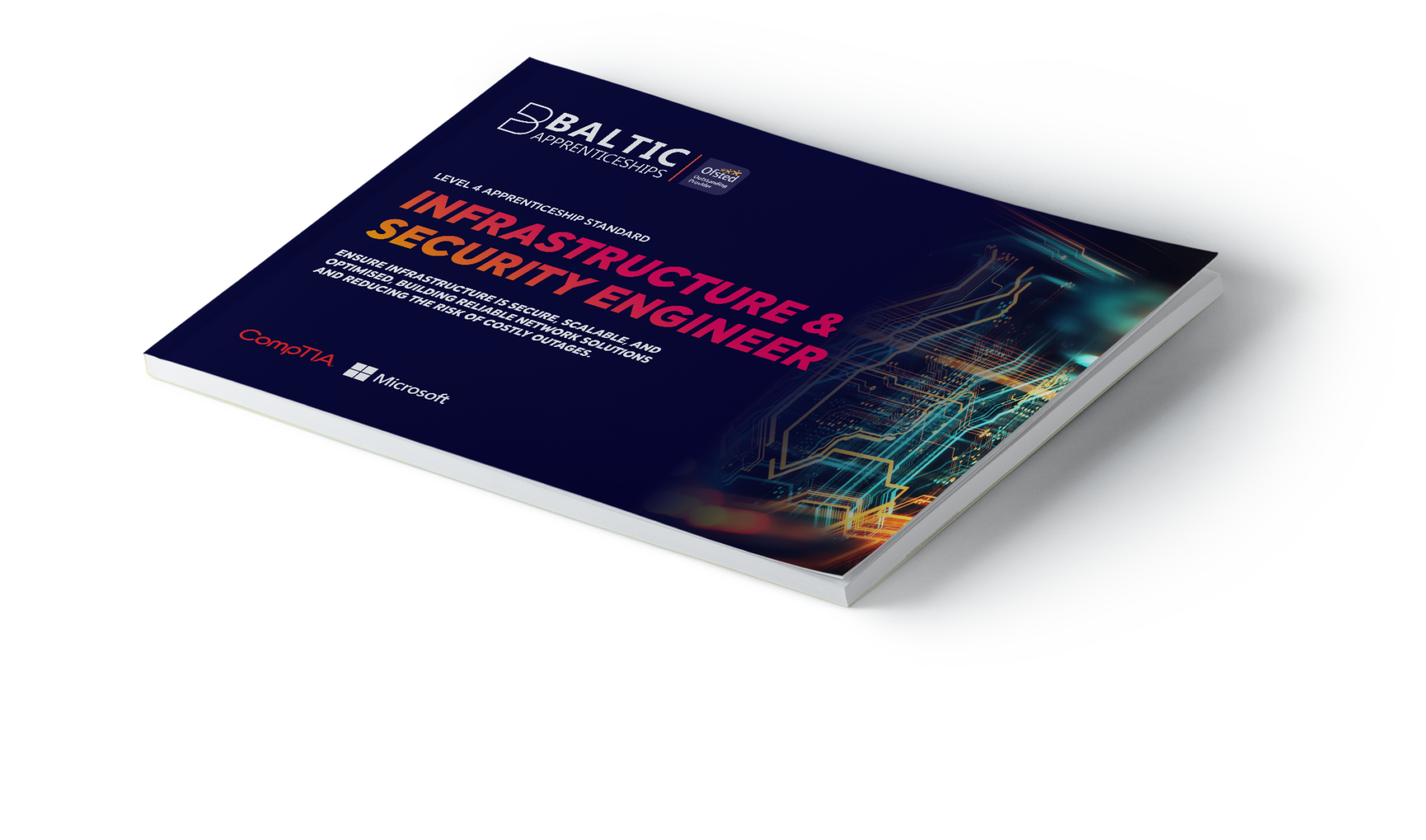
Evaluate your current systems, team capabilities, and response plans to identify gaps or inefficiencies.
Assess Cyber ReadinessUnderstand the most common vulnerabilities businesses face and how to harden your entry points with a cybersecurity apprenticeship.
Identify Frontline RisksLearn how ongoing skills development can transform your infrastructure resilience long term.
Get Expert AdviceDiscover why your biggest cyber risk isn’t your tech – it’s your team. Social engineering, phishing, and human error are now the leading causes of breaches – and most businesses aren’t equipped to respond.
This powerful whitepaper explores how organisations can turn their greatest vulnerability into their strongest defence by embedding cybersecurity capability directly into their teams through practical development.
Packed with real-world insights, case examples, and actionable strategies, this whitepaper is essential reading for IT leaders, HR teams, and business owners who want to move beyond box-ticking and build lasting cyber resilience.
Download our WhitepaperWe deliver a wide range of apprenticeship programmes across multiple sectors, supporting employers and learners at every stage of their journey.
Our Level 3 AI Enablement programme enables learners to use AI confidently, reducing manual work, and improving how systems are used across the business.
Our Level 3 Data & Business Insights apprenticeship builds the skills needed to unlock data capabilities and spark digital transformation. By the end of this course, apprentices will have the confidence to make data-driven decisions.
Our Level 3 IT Support apprenticeship creates expert IT Technicians with exceptional problem-solving skills. Apprentices will learn to optimise systems, configure devices, and provide outstanding customer service.
Our Level 3 Modern Marketing Professional apprenticeship develops the skills to understand audiences, create compelling content, plan and deliver integrated campaigns, and use data and AI responsibly to improve marketing performance.
Our Level 3 Content Creator apprenticeship transforms creative flair into marketing skills. We empower people to produce high-quality content that maximises audience engagement on modern marketing channels.
Our Level 4 AI & Digital Transformation programme develops internal leaders who can embed data-driven decision-making, support technology adoption, and build confidence with automation and AI tools.
Our Level 4 AI for Business Automation programme enables learners to identify automation opportunities, implement AI solutions confidently, and deliver measurable business value across the organisation.
Our Level 4 Data Analyst apprenticeship develops professionals who can turn organisational data into clear, actionable insight, empowering learners to move beyond reporting to support smarter, data-driven decisions.
Our Level 4 Infrastructure and Security Engineer apprenticeship develops the skills to design, maintain, secure, and optimise modern network infrastructure across cloud, hybrid, and on-premise environments, helping organisations support resilient digital operations.
Our Level 4 Marketing Executive apprenticeship equips marketers with a deeper understanding of marketing approaches and strategy. We teach people how to plan and execute tactical and targeted marketing activities that lead to conversions.
Our Level 4 Software Developer apprenticeship is the solution for people looking for the next step in their software career. Building on existing knowledge, we teach advanced project management skills & development practices, creating future leaders.
Our Level 4 Sustainability for Business Impact apprenticeship is designed for Sustainability Managers and Business Leaders, providing an ROI-focused training solution to embed sustainable practices into operations that deliver immediate business impact.
Our Level 5 Data Engineer apprenticeship develops strategic, business-minded engineers. Participants gain hands-on experience with data products, platforms, data pipelines, and AI-enabled engineering – aligning technical solutions with broader organisational goals.
Want to learn more about how Cybersecurity apprenticeships can support your team? Fill out the form and a member of our team will be in touch.
Cybersecurity apprenticeships are paid roles where someone works in your business while training with an approved Cybersecurity apprenticeship provider. You provide real work, support and a salary; the provider delivers structured Cybersecurity training and helps monitor progress and compliance.
Levy-paying employers will usually fund Cybersecurity apprenticeships using their Apprenticeship Levy funds.
For apprentices aged 16–24, apprenticeship training is fully funded for all employers. If you’re a levy-paying employer, the cost of training will be paid using your levy funds. If those funds have been exhausted, the Government will fully fund the remaining apprenticeship training costs.
For apprentices aged 25 and over, non-levy employers contribute 5% towards apprenticeship training costs, with the Government funding the remaining 95%. If you’re a levy-paying employer and your levy funds have been exhausted, you’ll contribute 25% of the training costs, with the Government funding the remaining 75%.
In addition to any training costs, employers are responsible for paying their apprentice’s salary, which must be at least the applicable National Minimum Wage.
IT apprenticeship training providers help you identify the right apprenticeship standard, advertise your vacancy, screen applicants and match you with suitable candidates.
They also support with off-the-job training, handle individual learning plans, support with reviews, and prepare your apprentice for End-Point Assessment.
When looking for a Cybersecurity Apprenticeship provider, check the provider’s Ofsted rating, completion rates, QAR data, and experience with Cybersecurity apprenticeships. Look for strong employer reviews, flexible delivery, and clear support for both you and your apprentices.
A Level 3 Cybersecurity apprenticeship is equivalent to A Levels. It’s ideal for new starters or junior staff who are building foundational Cybersecurity skills.
Level 3 apprenticeships focus on core technical abilities such as IT support, troubleshooting, networking basics and digital systems, making them a strong fit for entry‑level roles and growing early‑stage talent within your organisation.
A Level 4 Cybersecurity apprenticeship is a higher apprenticeship, roughly equivalent to the first year of a degree. It suits staff with existing Cybersecurity skills who are ready for more complex work, such as Network Engineering.
A Cybersecurity apprenticeship is a paid job where you learn on the job while training with a Cybersecurity apprenticeship provider. You gain real work experience, a salary, and recognised qualifications, without paying tuition fees yourself.
Compare Cybersecurity apprenticeship providers by the standards they offer, their Ofsted rating, and learner reviews – also look at how they deliver training (online, in‑person, or blended) and the level of support they provide throughout your apprenticeship.
A Level 3 Cybersecurity apprenticeship is an apprenticeship equivalent to A level study. It’s a great next step after GCSEs or for people with an interest in Cybersecurity who want to build core skills for roles like IT Support Technician.
A Level 4 Cybersecurity apprenticeship is a higher apprenticeship, similar in level to the first year of a degree. It’s ideal if you’ve already done a Level 3, A Levels or have some Cybersecurity experience and want roles like Infrastructure & Security Engineer.
You usually need to be 16+ years-old, live and work in England, and not be in full‑time education. Individual apprenticeship providers may also ask for certain GCSEs (often English and Maths) or some Cybersecurity knowledge, especially for Level 4 Cybersecurity apprenticeships.